Legal snapshot
The Czech Republic is a contracting party to the CMR Convention. For qualifying international carriage of goods by road, the universal CMR rules apply: the contract of carriage, the consignment note, the Article 6 particulars, carrier liability, the reservation windows and the limitation periods. See the universal explainers — What is a CMR and Liability, claims & deadlines.
The Czech Republic is a significant Central European manufacturing and logistics hub, with a strong automotive and industrial export base — so CMR traffic to and from the country is heavy and route-dense.
Digital snapshot
The Czech Republic acceded to the 2008 Additional Protocol on 14 April 2011 — one of the earlier parties. It is a full Protocol party. The electronic consignment note can therefore be a legally recognised consignment note for carriage involving the Czech Republic, provided the e-CMR meets the Protocol’s authentication, integrity and procedural requirements (see e-CMR explained).
Because Czech freight routes typically cross several borders, the weakest-link rule applies — check the e-CMR status of every country on the route. e-CMR remains optional.
As an EU member state, eFTI applies in the Czech Republic. From 9 July 2027, Czech competent authorities must accept compliant electronic freight information via certified eFTI platforms. eFTI does not make e-CMR mandatory for Czech businesses.
National practice
Domestic carriage. Czech law applies the CMR provisions on concluding and performing the contract of carriage, carrier liability, claims and actions, and successive carriers by analogy to domestic road haulage (section 9a of Act No. 111/1994 Coll. on Road Transport). Separately, a carrier established in the Czech Republic must make sure that each of its large vehicles carries a cargo document (doklad o nákladu) and keep that document for two years after the carriage (section 3(1)(b) of the same Act); large vehicles are those over 3.5 tonnes, and those over 2.5 tonnes in international carriage or cabotage (section 2(15)). For carriage for hire, the cargo document shows the carrier’s name, registered office and company ID number, the vehicle registration, the client, the consignee, the type and weight of the load, the place and date of loading, and the place and expected date of unloading (Decree No. 478/2000 Coll., section 1(1)).
E-invoicing. According to the European Commission (October 2026), Czech public contracting authorities must accept and process e-invoices that follow the European standard since 1 October 2016 (Act No. 134/2016 Coll. on Public Procurement); the Czech Republic has no B2G, B2B or B2C e-invoicing mandate.
Retention. Under the Accounting Act (Act No. 563/1991 Coll., section 31(2)), accounting documents and books are kept for five years and the financial statements and annual report for ten years, counted from the end of the accounting period they relate to. VAT documents are kept for ten years from the end of the tax period in which the supply took place (Act No. 235/2004 Coll. on VAT, section 35(2)).
Watch items
- 9 July 2027 — eFTI authority acceptance: Czech authorities must accept compliant electronic freight data via certified eFTI platforms.
- 1 July 2030, cross-border B2B e-invoicing in the EU: from this date, invoices for supplies between businesses in different EU countries that fall under the new digital reporting obligation are issued as electronic invoices in the European standard (Council Directive (EU) 2025/516, articles 5 and 6(5)).
Country FAQ
Can I use e-CMR in the Czech Republic? Yes. The Czech Republic acceded to the 2008 e-CMR Protocol in 2011, so the electronic consignment note can be legally recognised for carriage involving the country, provided it meets the Protocol’s requirements. Check every other country on the route too.
Does eFTI apply in the Czech Republic? Yes. The Czech Republic is an EU member state, so the eFTI Regulation applies. From 9 July 2027, Czech authorities must accept compliant electronic freight information via certified eFTI platforms.
Is e-CMR mandatory in the Czech Republic? No. e-CMR is optional: the e-CMR Protocol allows an electronic consignment note (article 2(1)), and the eFTI Regulation obliges authorities to accept electronic freight information, not businesses to provide it (articles 4(2) and 5(1)).
Printing the form: In the Czech Republic you can print a complete CMR consignment note yourself on blank paper.
Your CMR in Czech, from your own printer
One A4 page with the 24 numbered boxes of the familiar CMR, in four copies, with the QR code on every copy. You fill it in in your browser and print it on blank A4 paper.
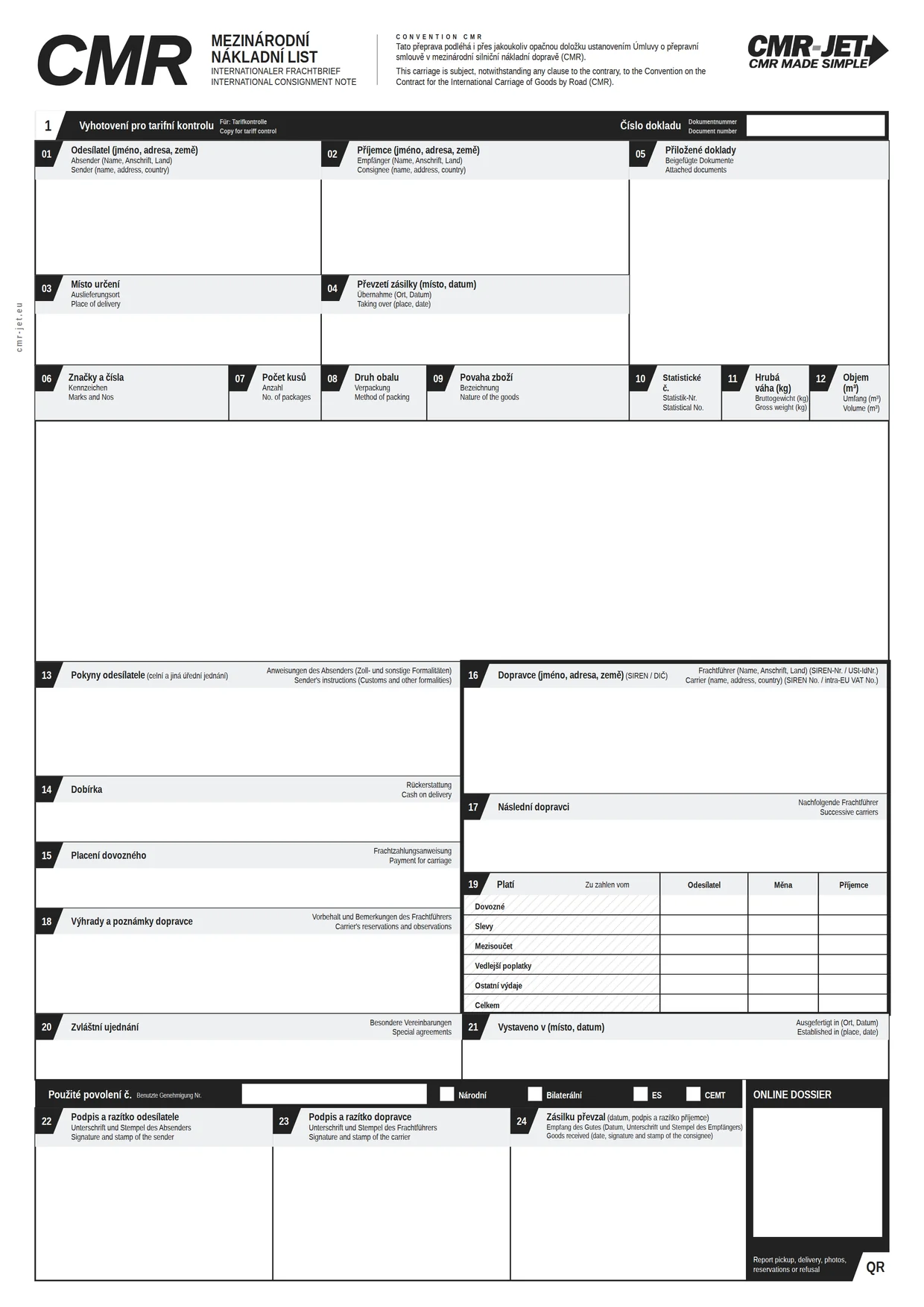
- Three languages on one form. Every box carries its Czech title with the German and English titles below.
- The signed CMR comes back. The consignee or the driver scans the QR code, without an app, and takes a photo of the signed CMR. That photo is added to the document. When proof of delivery comes back the same day, your invoice can go out the same day.
You work in CMR-JET in English, Dutch, German or French; the CMR itself prints in Czech.
14-day free trial, no credit card. For businesses with a VAT number only.
After the click there is first a quick check that you are not a robot. Then you create your account and enter the name and country of your company. Then you make your first CMR.