Legal snapshot
Spain is a contracting party to the CMR Convention. For qualifying international carriage of goods by road, the universal CMR rules apply: the contract of carriage, the consignment note, the Article 6 particulars, carrier liability, the reservation windows and the limitation periods. See the universal explainers — What is a CMR and Liability, claims & deadlines.
Digital snapshot
Spain acceded to the 2008 Additional Protocol on 11 May 2011 and is a full party to it. The electronic consignment note can therefore be a legally recognised consignment note for carriage involving Spain, provided the e-CMR meets the Protocol’s authentication, integrity and procedural requirements (see e-CMR explained).
On international routes the weakest-link rule applies — check every country involved. e-CMR remains optional under the Protocol.
As an EU member state, eFTI applies in Spain. From 9 July 2027, Spanish competent authorities must accept compliant electronic freight information via certified eFTI platforms. eFTI does not itself make e-CMR mandatory for businesses.
National practice
Digital since 5 October 2026: the DeCA. It is the most important recent change in Spanish road-freight paperwork, but it applies to domestic transport inside Spain (cabotage included), not to international carriage under the CMR.
Spain has two distinct freight documents. The carta de porte is the consignment note (the Spanish CMR / transport contract document). The Documento electrónico de control administrativo (DeCA) is a separate administrative control document: the proof that a road carriage of goods meets the minimum data required by Spanish regulation (contractual shipper, effective carrier, origin and destination, date, nature and weight of the goods, vehicle registration), used for roadside inspections.
Under the Ley 9/2025 de Movilidad Sostenible (the Sustainable Mobility Law, published in the BOE in December 2025), the DeCA must be exclusively digital from 5 October 2026, ten months after the law entered into force. From that date the control document must be digital. The driver carries a copy on a phone or on paper, and either copy must carry the QR code; handwritten notes on a paper copy do not count. The DeCA must be issued, stored and presented electronically, and presentable at roadside checks through a QR code that leads to a secure web address (https) from which inspectors download the document as a PDF. It must meet requirements of availability, integrity, unalterability and inviolability of content.
Important distinction: the DeCA is not the CMR. The CMR (or e-CMR) is the consignment note for international carriage; it records the contract of carriage. The DeCA is the control document for domestic carriage. For domestic carriage another transport document may serve as DeCA only if it carries all the required data and its format meets the Resolución.
Who it affects. The DeCA applies to domestic public road freight in Spain, including cabotage by foreign carriers. International carriage to, from or through Spain uses the CMR instead. Responsibility is shared between the contractual shipper (cargador) and the actual carrier.
E-invoicing. Spain also has B2B e-invoicing reform under the Crea y Crece law: under Real Decreto 238/2026 it is obligatory from 6 October 2027 for businesses with turnover above EUR 8 million and from 6 October 2028 for all others. The “Verifactu” billing-software rules are a related strand.
Retention. The DeCA files must be kept for at least one year.
Watch items
- 9 July 2027: eFTI authority acceptance. Spanish authorities must accept compliant electronic freight data via certified eFTI platforms.
- 6 October 2027: B2B e-invoicing (Crea y Crece). Obligatory for businesses with turnover above EUR 8 million; from 6 October 2028 for all others (Real Decreto 238/2026).
Country FAQ
What is the DeCA and is it the same as a CMR? No. The DeCA (documento electrónico de control administrativo) is the control document for domestic carriage in Spain, used for roadside inspections. The CMR (or e-CMR) is the consignment note for international carriage; it records the contract of carriage. They are different documents.
When did the digital DeCA become mandatory? Since 5 October 2026 the DeCA must be digital for domestic public road transport of goods in Spain, under the Ley 9/2025 de Movilidad Sostenible. The driver carries a copy on a phone or on paper, and either copy must carry the QR code; handwritten notes on a paper copy do not count.
Does the DeCA affect non-Spanish companies? Only for domestic carriage in Spain. A foreign carrier that does cabotage in Spain must have the DeCA. International carriage to, from or through Spain is not covered; it uses the CMR. For domestic carriage, the contractual shipper and the actual carrier share responsibility.
Can I use e-CMR in Spain? Yes. Spain is a party to the 2008 e-CMR Protocol, so the electronic consignment note can be legally recognised for carriage involving Spain, provided it meets the Protocol’s requirements. The DeCA is a separate matter: it applies to domestic carriage only, and the ministry states that the e-CMR is not mandatory for international carriage.
Does eFTI apply in Spain? Yes. Spain is an EU member state, so the eFTI Regulation applies. From 9 July 2027, Spanish authorities must accept compliant electronic freight information via certified eFTI platforms.
Printing the form: In Spain you can print a complete CMR consignment note yourself on blank paper. For carriage inside Spain, including cabotage, the separate control document (DeCA) must be digital; a printed consignment note is not a DeCA. International carriage is outside the DeCA (Resolution of 5 June 2026, BOE-A-2026-12784).
Your CMR in Spanish, from your own printer
One A4 page with the 24 numbered boxes of the familiar CMR, in four copies, with the QR code on every copy. You fill it in in your browser and print it on blank A4 paper.
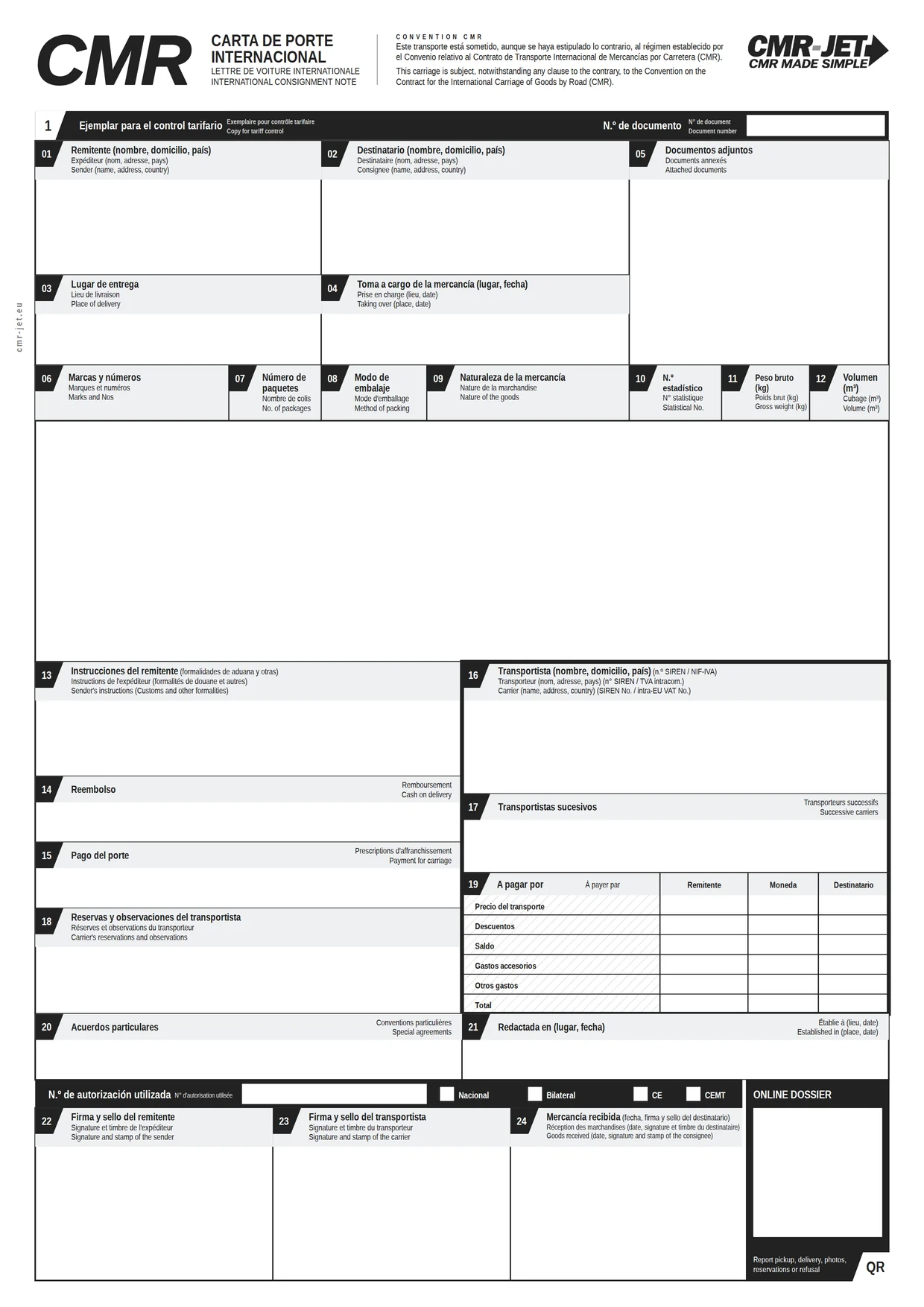
- Made for your international shipments. CMR-JET makes the international CMR. The DeCA for carriage inside Spain is a separate digital document, and CMR-JET does not make it.
- Three languages on one form. Every box carries its Spanish title with the French and English titles below.
- The signed CMR comes back. The consignee or the driver scans the QR code, without an app, and takes a photo of the signed CMR. That photo is added to the document. You see what is delivered, without the phone calls.
You work in CMR-JET in English, Dutch, German or French; the CMR itself prints in Spanish.
14-day free trial, no credit card. For businesses with a VAT number only.
After the click there is first a quick check that you are not a robot. Then you create your account and enter the name and country of your company. Then you make your first CMR.