Legal snapshot
Poland is a contracting party to the CMR Convention. For qualifying international carriage of goods by road, the universal CMR rules apply: the contract of carriage, the consignment note, the Article 6 particulars, carrier liability, the reservation windows and the limitation periods. See the universal explainers — What is a CMR and Liability, claims & deadlines.
Poland matters disproportionately here: it is the largest road-freight market in the EU by international tonne-kilometres. A very large share of intra-EU CMR traffic involves a Polish carrier, so the Polish page is relevant far beyond Poland itself.
Digital snapshot
Poland acceded to the 2008 Additional Protocol on 13 June 2019 and is a Protocol party. The electronic consignment note can therefore be a legally recognised consignment note for carriage involving Poland, provided the e-CMR meets the Protocol’s authentication, integrity and procedural requirements (see e-CMR explained).
Given the scale of the Polish carrier sector, Poland is an important country for e-CMR adoption in practice — when Polish carriers move to electronic notes, the effect ripples across European supply chains. On international routes the weakest-link rule still applies. e-CMR is optional.
As an EU member state, eFTI applies in Poland. From 9 July 2027, Polish competent authorities must accept compliant electronic freight information via certified eFTI platforms. eFTI does not make e-CMR mandatory for Polish businesses.
PRACTICE— Poland also operates SENT, a national electronic system for monitoring the road (and rail) carriage of certain “sensitive” goods (such as fuels, alcohol and tobacco). SENT is a separate monitoring obligation, not the consignment note and not eFTI — but Polish shippers of those goods should be aware it exists alongside the CMR.
National practice
The domestic list przewozowy. List przewozowy is the Polish word for a consignment note; the official Polish text of the CMR uses it too. For domestic carriage, the Polish Transport Law (Prawo przewozowe) has the sender hand the carrier a consignment note with the particulars of article 38, or give the information in another way where that is common practice for the type of carriage (article 38(1)). The consignment note confirmed by the carrier proves the contract of carriage and may also be an electronic message, a computer printout or another document with those particulars (article 47(3)).
E-invoicing — KSeF. The obligation to issue structured invoices through Poland’s national e-invoicing system, the Krajowy System e-Faktur (KSeF), took effect on 1 February 2026. Transitional rules let taxpayers whose sales including VAT did not exceed PLN 200 million in 2024 keep issuing other electronic or paper invoices until 31 March 2026, and let taxpayers whose invoiced sales including VAT stay at or below PLN 10,000 a month do so until 31 December 2026 (VAT Act, articles 145l and 145m). As elsewhere, this is a back-office development, but it pushes Polish businesses firmly toward structured digital workflows.
Retention. Under the Tax Ordinance (articles 86(1) and 70(1)), taxpayers who keep tax books keep the books and the documents connected with them until the tax liability is time-barred, as a rule five years from the end of the calendar year in which the tax payment deadline passed. Under the Accounting Act (article 74(2) and (3)), accounting books and most accounting documents are kept for at least five years from the beginning of the year following the financial year they relate to.
Watch items
- 31 December 2026 — last KSeF transition ends: taxpayers whose invoiced sales including VAT stay at or below PLN 10,000 a month may issue other electronic or paper invoices until this date (VAT Act, article 145m).
- 9 July 2027 — eFTI authority acceptance: Polish authorities must accept compliant electronic freight data via certified eFTI platforms.
- SENT monitoring: ongoing national monitoring of sensitive-goods carriage — relevant for shippers of fuels, alcohol, tobacco and similar goods.
Country FAQ
Can I use e-CMR in Poland? Yes. Poland acceded to the 2008 e-CMR Protocol in 2019, so the electronic consignment note can be legally recognised for carriage involving Poland, provided it meets the Protocol’s requirements. Check every other country on an international route too.
Is the list przewozowy the same as a CMR? List przewozowy simply means consignment note, and the official Polish text of the CMR uses the same word. For international carriage the CMR particulars (Article 6) apply; for domestic carriage the Polish Transport Law sets its own particulars (article 38).
Does eFTI apply in Poland? Yes. Poland is an EU member state, so the eFTI Regulation applies. From 9 July 2027, Polish authorities must accept compliant electronic freight information via certified eFTI platforms.
What is SENT? SENT is Poland’s national electronic system for monitoring the carriage of certain sensitive goods (such as fuels, alcohol and tobacco). It is a separate monitoring obligation — not the consignment note and not eFTI. Before the transport starts, the carrier must give the driver the SENT reference number, and the driver must have it when the transport starts (SENT Act, article 10(2) and (3)).
Is KSeF related to transport documents? Not directly. KSeF is Poland’s national e-invoicing system. But it moves Polish businesses toward structured digital workflows, which makes a digital proof-of-delivery and document process a natural companion.
Printing the form: In Poland you can print a complete CMR consignment note yourself on blank paper. Polish transport law expressly allows a consignment note to be a computer printout (Transport Law, article 47(3)).
Your CMR in Polish, from your own printer
One A4 page with the 24 numbered boxes of the familiar CMR, in four copies, with the QR code on every copy. You fill it in in your browser and print it on blank A4 paper.
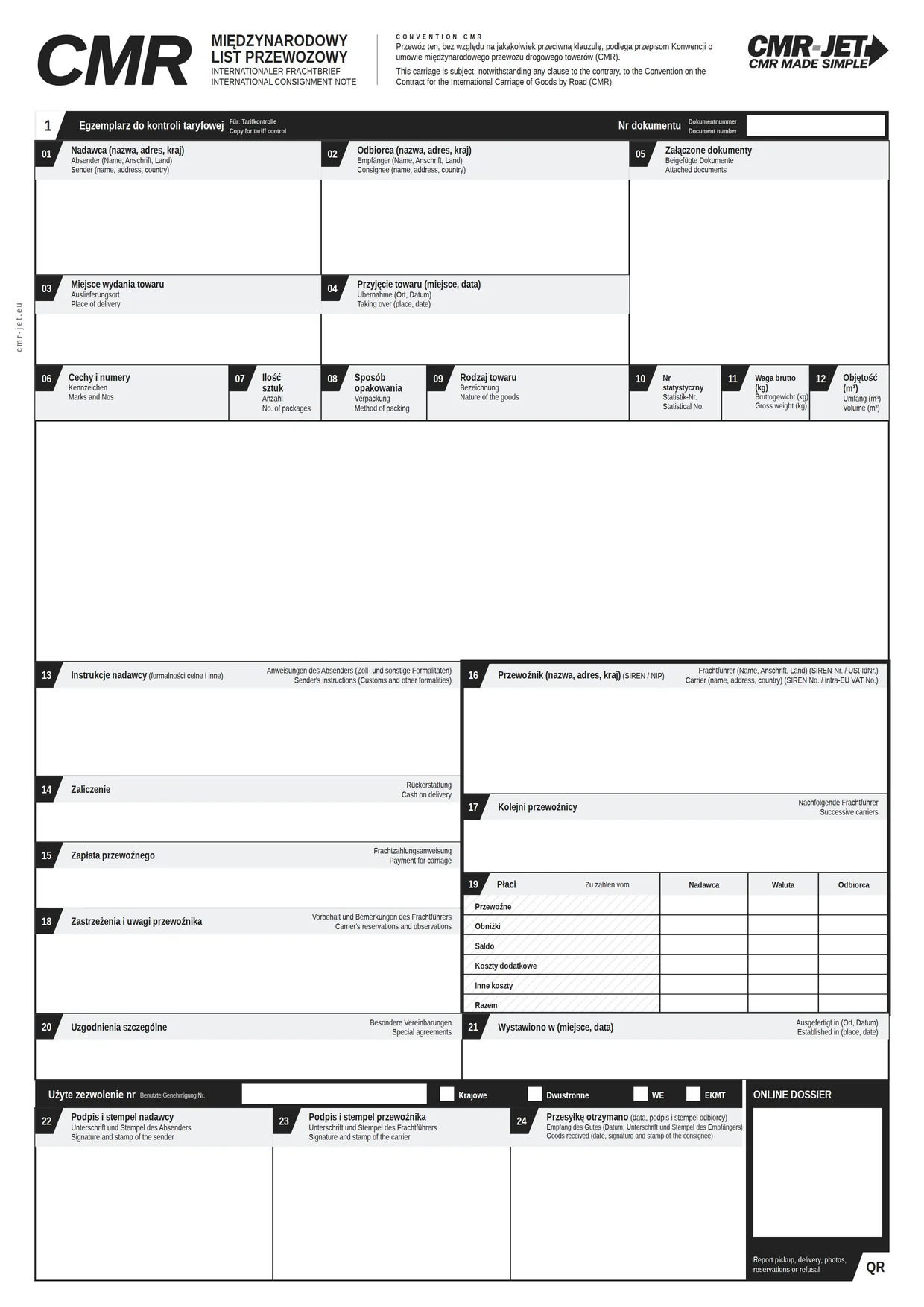
- No pre-printed sets in stock. You print a CMR when you need one, on blank A4 paper, in four copies.
- Three languages on one form. Every box carries its Polish title with the German and English titles below.
- The signed CMR comes back. The consignee or the driver scans the QR code, without an app, and takes a photo of the signed CMR. That photo is added to the document. When proof of delivery comes back the same day, your invoice can go out the same day.
You work in CMR-JET in English, Dutch, German or French; the CMR itself prints in Polish.
14-day free trial, no credit card. For businesses with a VAT number only.
After the click there is first a quick check that you are not a robot. Then you create your account and enter the name and country of your company. Then you make your first CMR.