Legal snapshot
Italy is a contracting party to the CMR Convention. For qualifying international carriage of goods by road, the universal CMR rules apply: the contract of carriage, the consignment note, the Article 6 particulars, carrier liability, the reservation windows and the limitation periods. See the universal explainers — What is a CMR and Liability, claims & deadlines.
Digital snapshot
Italy acceded to the 2008 Additional Protocol on 28 June 2024 and is a Protocol party. The electronic consignment note can therefore be a legally recognised consignment note for carriage involving Italy, provided the e-CMR meets the Protocol’s authentication, integrity and procedural requirements (see e-CMR explained).
Italy acceded recently, so domestic e-CMR adoption is still maturing. On international routes the weakest-link rule applies — check every country involved and keep a paper note where any country is not a Protocol party. e-CMR is optional.
As an EU member state, eFTI applies in Italy. From 9 July 2027, Italian competent authorities must accept compliant electronic freight information via certified eFTI platforms. eFTI does not make e-CMR mandatory for Italian businesses.
National practice
The domestic DDT. Italy’s Documento di Trasporto (DDT) is a fiscal document of the seller: it shows the date, the seller, the buyer and any carrier, and the nature, quality and quantity of the goods (DPR 472/1996, article 1(3)). Deliveries documented by a DDT to the same buyer in one month may be invoiced together, later (fattura differita) (DPR 633/1972, article 21(4)(a); from 1 January 2027, article 72(4)(a) of the VAT Consolidated Act, Legislative Decree 10/2026). The general duty to have goods accompanied by a documento di accompagnamento dei beni viaggianti (“bolla di accompagnamento”) ended in 1996, except for tobacco, matches and excise goods when first placed on the market (article 1(1) and (1-bis)). The DDT is distinct from the international CMR consignment note: international carriage uses the CMR note; the DDT sits in the Italian fiscal layer.
PRACTICE— Italian shippers often think first of the DDT because it is the document their accounting process depends on. On a country page it is worth being explicit: the DDT is a fiscal/domestic document, the CMR is the international transport-contract document. They can travel together on the same shipment but they serve different purposes.
E-invoicing. Italy is a pioneer of mandatory electronic invoicing. B2B and B2C e-invoicing through the national exchange system (Sistema di Interscambio, SdI) has been broadly mandatory since 2019, with the scope extended in later years. As a result, Italian businesses already operate in a highly structured digital invoicing environment — which lowers the barrier to digitising transport documentation too.
Retention. Under the Civil Code (article 2220), accounting records are kept for ten years from the date of the last entry, and so are invoices, letters and telegrams received and copies of those sent; they may be kept as image recordings if these match the documents and can be made readable at any time.
Watch items
- 9 July 2027 — eFTI authority acceptance: Italian authorities must accept compliant electronic freight data via certified eFTI platforms.
- Domestic e-CMR adoption: Italy acceded to the Protocol only in 2024 — practical uptake is still growing.
- E-invoicing scope: Italy’s mandatory e-invoicing scope has expanded over time; worth monitoring for further extensions.
Country FAQ
Can I use e-CMR in Italy? Yes. Italy acceded to the 2008 e-CMR Protocol in 2024, so the electronic consignment note can be legally recognised for carriage involving Italy, provided it meets the Protocol’s requirements. Check every other country on an international route too.
Is the DDT the same as a CMR? No. The DDT (Documento di Trasporto) is Italy’s domestic fiscal/commercial transport document, closely tied to deferred invoicing. The CMR is the international transport-contract consignment note. They are different documents.
Does eFTI apply in Italy? Yes. Italy is an EU member state, so the eFTI Regulation applies. From 9 July 2027, Italian authorities must accept compliant electronic freight information via certified eFTI platforms.
Does Italy’s e-invoicing system affect transport documents? Not directly — but Italy’s mature mandatory e-invoicing environment means Italian businesses are already used to structured digital documents, which makes digitising transport documentation a smaller step.
Printing the form: In Italy you can print a complete CMR consignment note yourself on blank paper. The DDT remains a separate fiscal document of the seller.
Your CMR in Italian, from your own printer
One A4 page with the 24 numbered boxes of the familiar CMR, in four copies, with the QR code on every copy. You fill it in in your browser and print it on blank A4 paper.
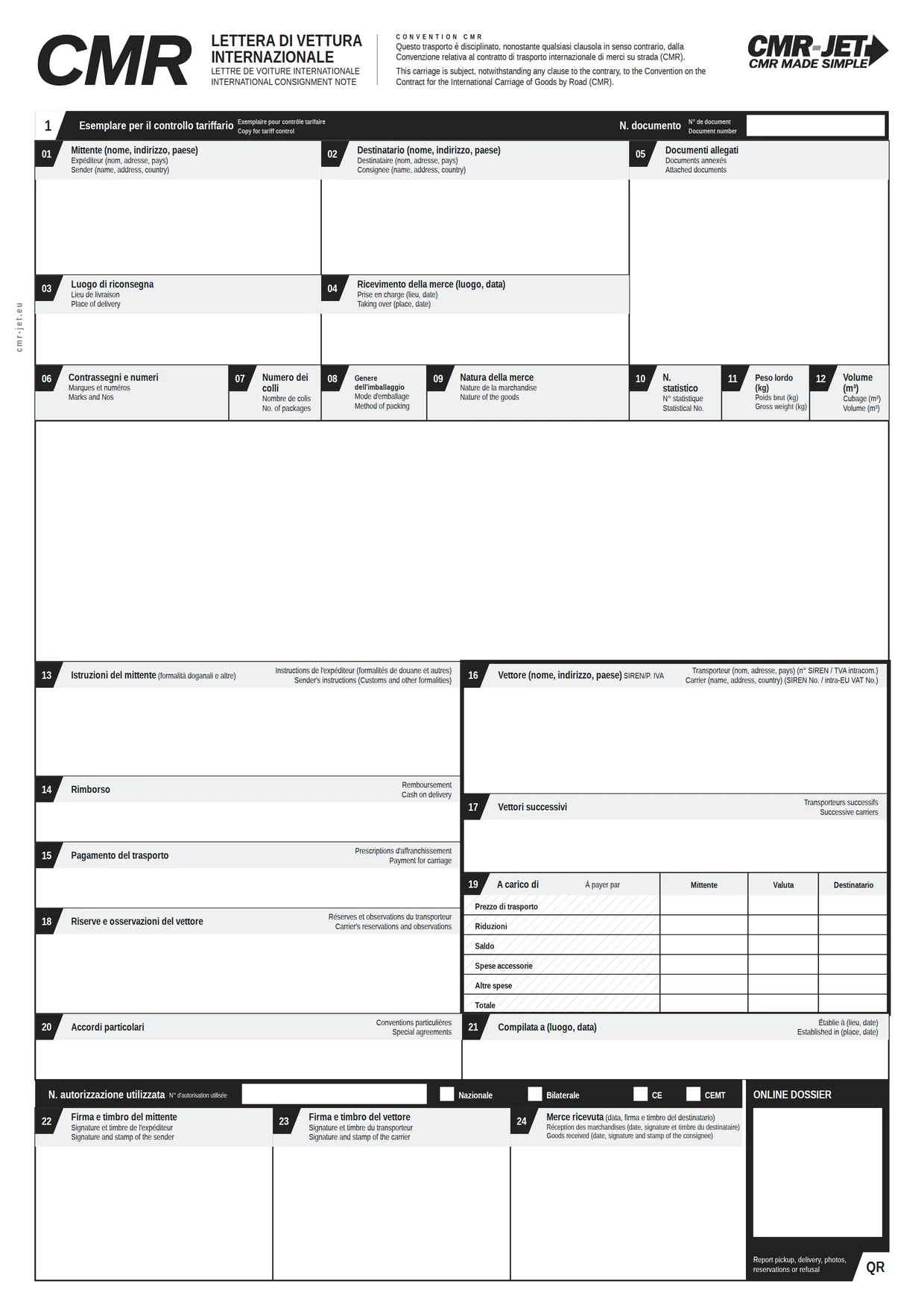
- The CMR next to your DDT. CMR-JET makes the CMR for your international shipments. You can add your DDT and your invoice to it as files, so the documents of one shipment sit together.
- Three languages on one form. Every box carries its Italian title with the French and English titles below.
- The signed CMR comes back. The consignee or the driver scans the QR code, without an app, and takes a photo of the signed CMR. That photo is added to the document. You see what is delivered, without the phone calls.
You work in CMR-JET in English, Dutch, German or French; the CMR itself prints in Italian.
14-day free trial, no credit card. For businesses with a VAT number only.
After the click there is first a quick check that you are not a robot. Then you create your account and enter the name and country of your company. Then you make your first CMR.