Legal snapshot
Romania is a contracting party to the CMR Convention. For qualifying international carriage of goods by road, the universal CMR rules apply: the contract of carriage, the consignment note, the Article 6 particulars, carrier liability, the reservation windows and the limitation periods. See the universal explainers — What is a CMR and Liability, claims & deadlines.
Romania has a large and fast-growing road-freight sector and is a major source of EU haulage capacity, so Romanian carriers appear on CMR traffic across the Union.
Digital snapshot
Romania acceded to the 2008 Additional Protocol on 14 March 2019 and is a full Protocol party. The electronic consignment note can therefore be a legally recognised consignment note for carriage involving Romania, provided the e-CMR meets the Protocol’s authentication, integrity and procedural requirements (see e-CMR explained).
On international routes the weakest-link rule applies — check the e-CMR status of every country involved. e-CMR remains optional.
As an EU member state, eFTI applies in Romania. From 9 July 2027, Romanian competent authorities must accept compliant electronic freight information via certified eFTI platforms. eFTI does not make e-CMR mandatory for Romanian businesses.
National practice
Domestic carriage. Romania applies the CMR (Article 1(2) and (3), Articles 2 to 30 and 32 to 41, except Article 23(3)) also to paid domestic road haulage of goods (Government Ordinance 27/2011, article 77(1)). For paid road haulage, the transport document on board is a CMR-type consignment note whose model is set out in Annex 14 to the methodological norms (Order 980/2011, article 39(2)).
RO e-Transport. Romania operates a national monitoring system, RO e-Transport, which requires advance electronic declaration of road transport of high-fiscal-risk goods within Romania and of international road transport of goods (Emergency Ordinance 41/2022, articles 1(2), 8 and 8¹); each declaration generates a unique code (a UIT code). The carrier holds the UIT code during the transport, on paper or electronically, together with the document that accompanies the goods, and the driver shows both on request of the tax authority, customs or the police (articles 2(12) and 10(1)). This is a Romanian fiscal-monitoring obligation, run by the tax authority (ANAF), and it is separate from the CMR consignment note and from eFTI. A shipper moving goods to, from or through Romania should treat RO e-Transport as an additional national requirement to check.
E-invoicing — RO e-Factura. Romania has rolled out mandatory electronic invoicing through the national RO e-Factura system. Mandatory B2B e-invoicing via the system has applied broadly from 2024, with the scope extended since. This is a back-office obligation distinct from transport documents, but it places Romanian businesses firmly in a structured digital environment.
Retention. Under the Accounting Law (Law 82/1991, article 25), mandatory accounting registers and the supporting documents behind the entries are kept for ten years from the end of the financial year in which they were drawn up (payroll records for 50 years); an order of the Minister of Finance may set five years for some registers and documents.
Watch items
- RO e-Transport: national monitoring of road movements of goods (UIT code). Scope and enforcement have changed repeatedly — monitor for the current rules.
- RO e-Factura: mandatory national e-invoicing — scope has expanded; worth monitoring for further extensions.
- 9 July 2027 — eFTI authority acceptance: Romanian authorities must accept compliant electronic freight data via certified eFTI platforms.
Country FAQ
Can I use e-CMR in Romania? Yes. Romania acceded to the 2008 e-CMR Protocol in 2019, so the electronic consignment note can be legally recognised for carriage involving Romania, provided it meets the Protocol’s requirements. Check every other country on the route too.
What is RO e-Transport? RO e-Transport is a Romanian national system requiring advance electronic declaration of certain road movements of goods, producing a UIT code that must accompany the transport. It is a fiscal-monitoring obligation — separate from the CMR consignment note and from eFTI.
Does eFTI apply in Romania? Yes. Romania is an EU member state, so the eFTI Regulation applies. From 9 July 2027, Romanian authorities must accept compliant electronic freight information via certified eFTI platforms.
Is RO e-Transport the same as eFTI? No. RO e-Transport is a Romanian national monitoring system. eFTI is an EU framework for authorities accepting electronic freight data. They are separate obligations.
Printing the form: In Romania you can print a complete CMR consignment note yourself on blank paper. If the transport falls under RO e-Transport, the driver must be able to show the UIT code, on paper or electronically, together with the consignment note.
Your CMR in Romanian, from your own printer
One A4 page with the 24 numbered boxes of the familiar CMR, in four copies, with the QR code on every copy. You fill it in in your browser and print it on blank A4 paper.
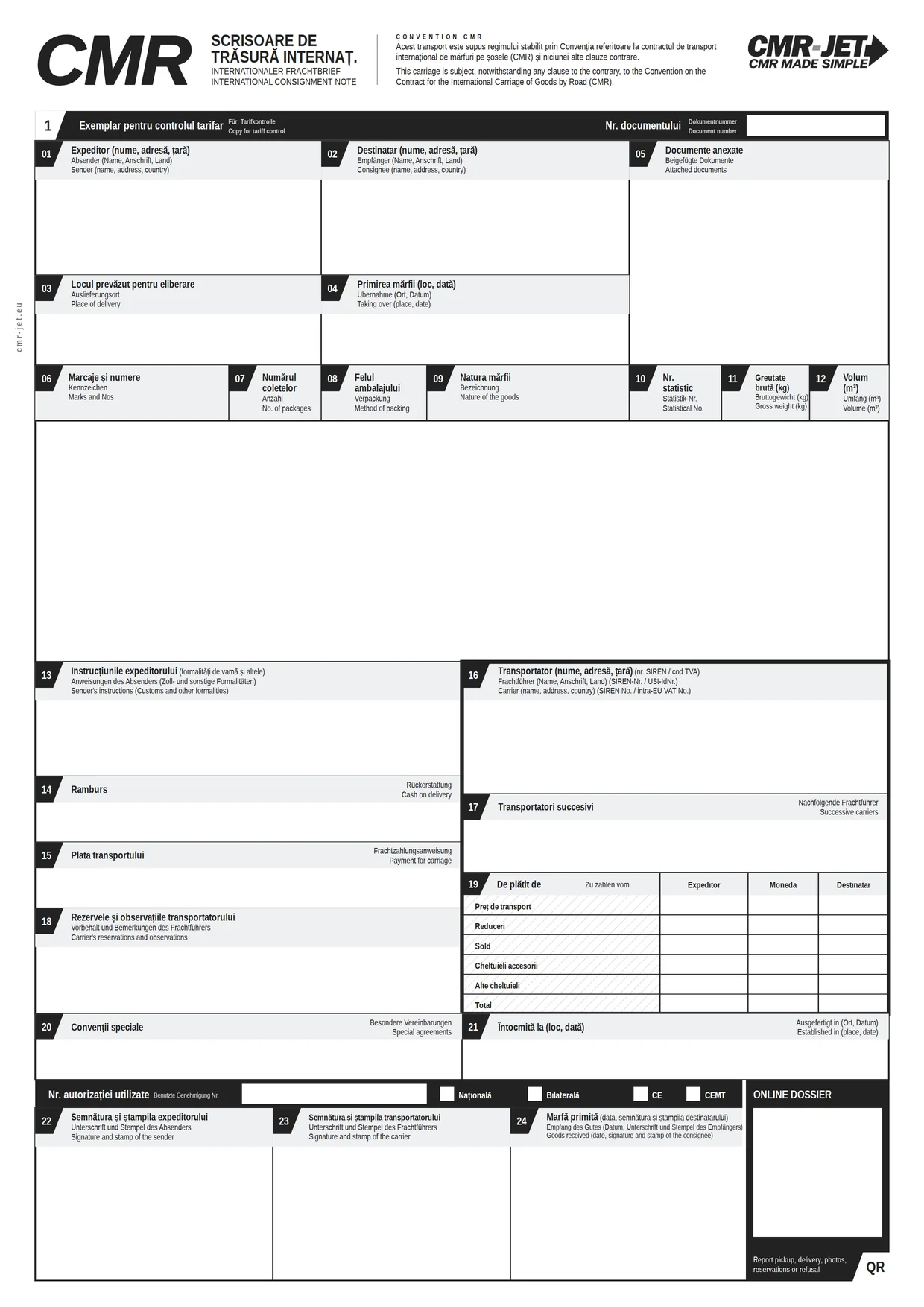
- Room for the UIT code on the sheet. If you want the UIT code on paper with the consignment note, you can type it in box 5 (attached documents) and it prints on every copy. The code itself comes from RO e-Transport, not from CMR-JET.
- Three languages on one form. Every box carries its Romanian title with the German and English titles below.
- The signed CMR comes back. The consignee or the driver scans the QR code, without an app, and takes a photo of the signed CMR. That photo is added to the document. When proof of delivery comes back the same day, your invoice can go out the same day.
You work in CMR-JET in English, Dutch, German or French; the CMR itself prints in Romanian.
14-day free trial, no credit card. For businesses with a VAT number only.
After the click there is first a quick check that you are not a robot. Then you create your account and enter the name and country of your company. Then you make your first CMR.