Legal snapshot
Cyprus is a contracting party to the CMR Convention. For qualifying international carriage of goods by road, the universal CMR rules apply: the contract of carriage, the consignment note, the mandatory Article 6 particulars, carrier liability, the reservation windows and the limitation periods. The universal explainers are the legal starting point — see How the CMR waybill works.
Digital snapshot — e-CMR
Cyprus is not a party to the 2008 Additional Protocol. The consignment note for carriage involving Cyprus should be on paper; e-CMR is not established as a legally recognised note here.
Digital snapshot — eFTI
As an EU member state, the EU's eFTI framework applies in Cyprus. From 9 July 2027, authorities must accept compliant electronic freight information shared via certified eFTI platforms. eFTI does not make e-CMR or any digital document mandatory for businesses.
National practice
Document retention: Under the Assessment and Collection of Taxes Law (4/1978, article 30(2)), books and records are kept at least six years from the tax-return deadline or the filing date, whichever is later.
E-invoicing: Cypriot central public bodies must receive and process e-invoices that follow the European standard since 18 April 2019, sub-central bodies since 18 April 2020; suppliers may send them voluntarily. According to the European Commission (October 2026), Cyprus has no B2G or B2B e-invoicing mandate for suppliers.
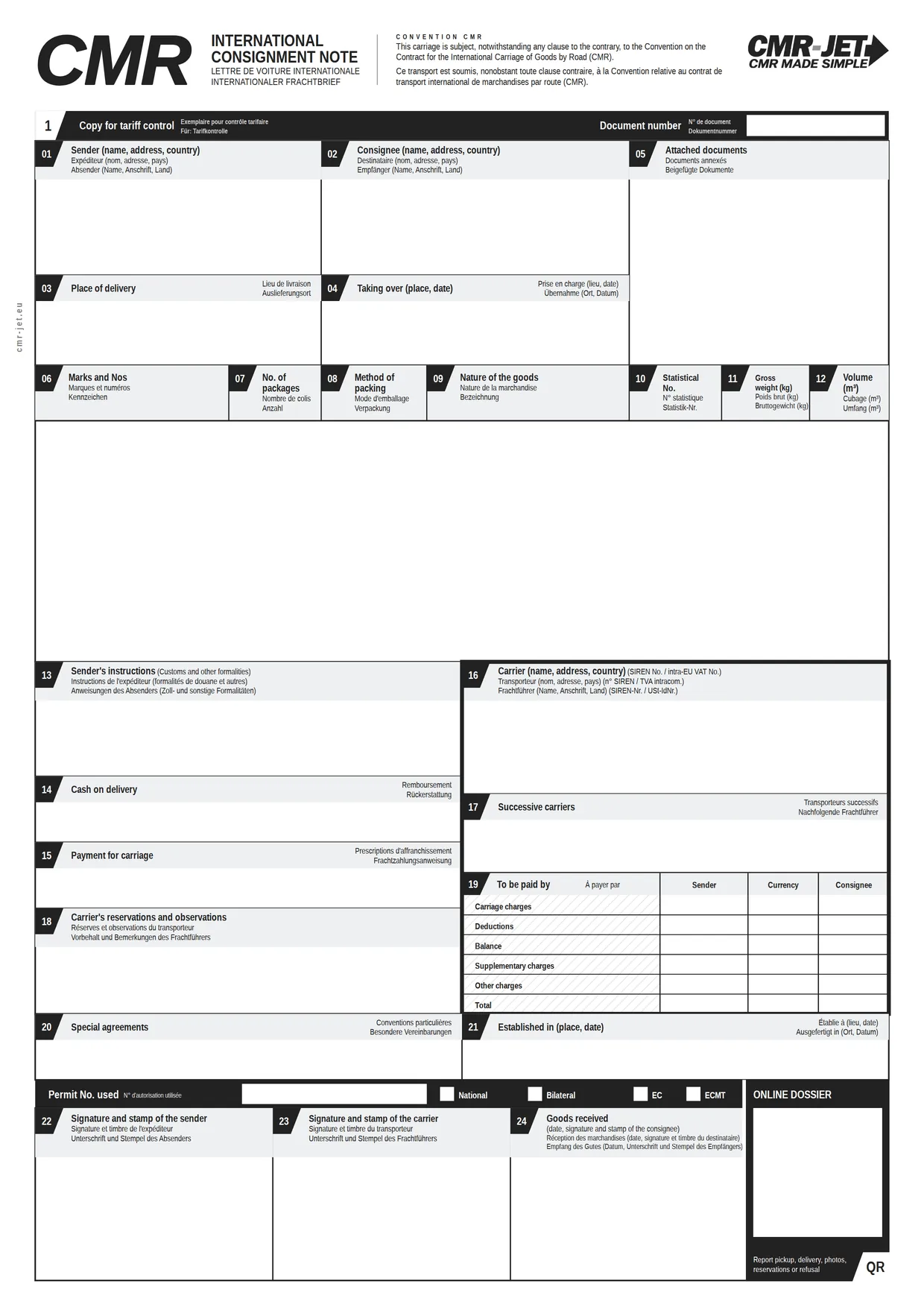
Printing the form: In Cyprus you can print a complete CMR consignment note yourself on blank paper.