Legal snapshot
Estonia is a contracting party to the CMR Convention. For qualifying international carriage of goods by road, the universal CMR rules apply: the contract of carriage, the consignment note, the mandatory Article 6 particulars, carrier liability, the reservation windows and the limitation periods. The universal explainers are the legal starting point — see How the CMR waybill works.
Digital snapshot — e-CMR
Estonia is a party to the 2008 Additional Protocol (accession on 2 November 2016, UN Treaty Collection). This means the electronic consignment note (e-CMR) can be a legally recognised consignment note for carriage involving Estonia, provided the Protocol's authentication, integrity and procedural requirements are met. e-CMR remains optional, not mandatory.
Digital snapshot — eFTI
As an EU member state, the EU's eFTI framework applies in Estonia. From 9 July 2027, authorities must accept compliant electronic freight information shared via certified eFTI platforms. eFTI does not make e-CMR or any digital document mandatory for businesses.
National practice
Domestic document note: In Estonia, on paid carriage of goods, domestic included, the driver must carry a transport document (veodokument) proving the contract of carriage, drawn up by the sender or the forwarder in a form that allows written reproduction; it may be electronic (Road Transport Act, section 29).
Document retention: Under the Accounting Act (section 12), source documents and the other business documents needed to understand transactions are kept seven years from the end of the financial year.
E-invoicing: E-invoicing has been mandatory for transactions with Estonian public-sector buyers since 1 July 2019. Since 1 July 2025 a business registered as an e-invoice receiver in the Commercial Register may require its suppliers to issue an e-invoice; an invoice that complies with EN 16931-1 is presumed properly drawn up.
- The transport document must state at least the sender, the carrier, the consignee, the place and date of loading, the place of unloading, the usual description of the goods and their gross mass or other quantity (Road Transport Act, section 29(4)).
- An Estonian translation of the CMR Convention is published in Riigi Teataja (RT II 1995, 3, 12), marked there as an unofficial translation; the authentic texts are English and French. The Convention entered into force for Estonia on 1 August 1993.
Printing the form: In Estonia you can print a complete CMR consignment note yourself on blank paper.
Your CMR in Estonian, from your own printer
One A4 page with the 24 numbered boxes of the familiar CMR, in four copies, with the QR code on every copy. You fill it in in your browser and print it on blank A4 paper.
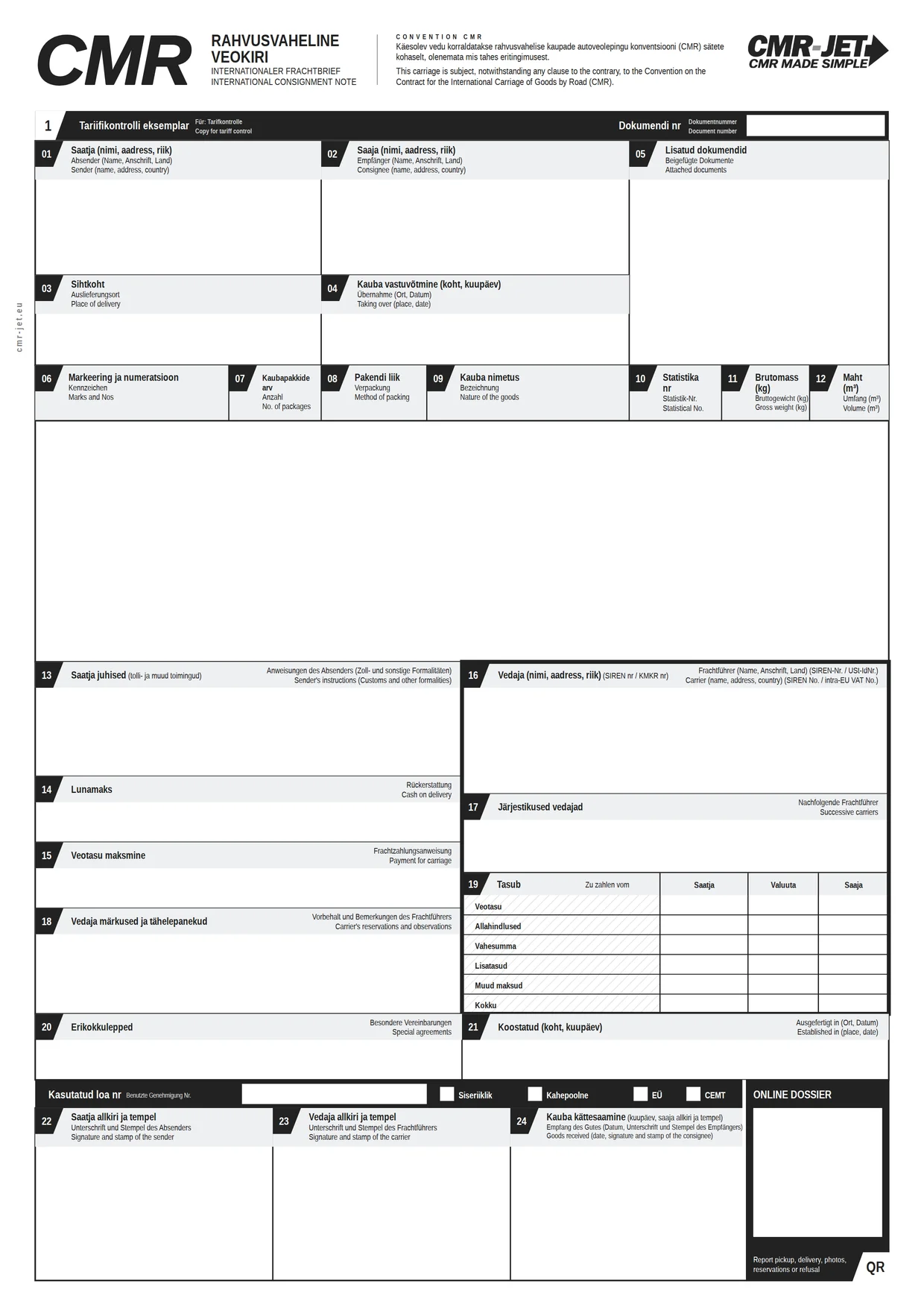
- No pre-printed sets in stock. You print a CMR when you need one, on blank A4 paper, in four copies.
- Three languages on one form. Every box carries its Estonian title with the German and English titles below.
- The signed CMR comes back. The consignee or the driver scans the QR code, without an app, and takes a photo of the signed CMR. That photo is added to the document. When proof of delivery comes back the same day, your invoice can go out the same day.
You work in CMR-JET in English, Dutch, German or French; the CMR itself prints in Estonian.
14-day free trial, no credit card. For businesses with a VAT number only.
After the click there is first a quick check that you are not a robot. Then you create your account and enter the name and country of your company. Then you make your first CMR.