Legal snapshot
Malta is a contracting party to the CMR Convention. For qualifying international carriage of goods by road, the universal CMR rules apply: the contract of carriage, the consignment note, the mandatory Article 6 particulars, carrier liability, the reservation windows and the limitation periods. The universal explainers are the legal starting point — see How the CMR waybill works.
Digital snapshot — e-CMR
Malta is not a party to the 2008 Additional Protocol. The consignment note for carriage involving Malta should be on paper; e-CMR is not established as a legally recognised note here.
Digital snapshot — eFTI
As an EU member state, the EU's eFTI framework applies in Malta. From 9 July 2027, authorities must accept compliant electronic freight information shared via certified eFTI platforms. eFTI does not make e-CMR or any digital document mandatory for businesses.
National practice
Domestic document note: Malta's International Carriage of Goods by Road Act (Cap. 486) gives the CMR Convention force of law for international carriage of goods by road, from 20 March 2008 (Legal Notice 52 of 2008). The Act covers international carriage only.
Document retention: VAT records are kept at least six years from the end of the year they relate to (VAT Act, Cap. 406, article 48(4)), and records under the Income Tax Management Act at least nine years after the transactions they relate to (Cap. 372, article 19(5)).
E-invoicing: Maltese contracting authorities must be able to receive and process e-invoices that follow the European standard for procurement above the EU thresholds (Legal Notices 403 and 404 of 2018), using the Peppol network. According to the European Commission (October 2026), Malta has no B2G or B2B e-invoicing mandate for suppliers and has been studying e-invoicing and real-time reporting.
- Malta's CMR Act sets out the Convention in English only (Cap. 486, article 5(3)).
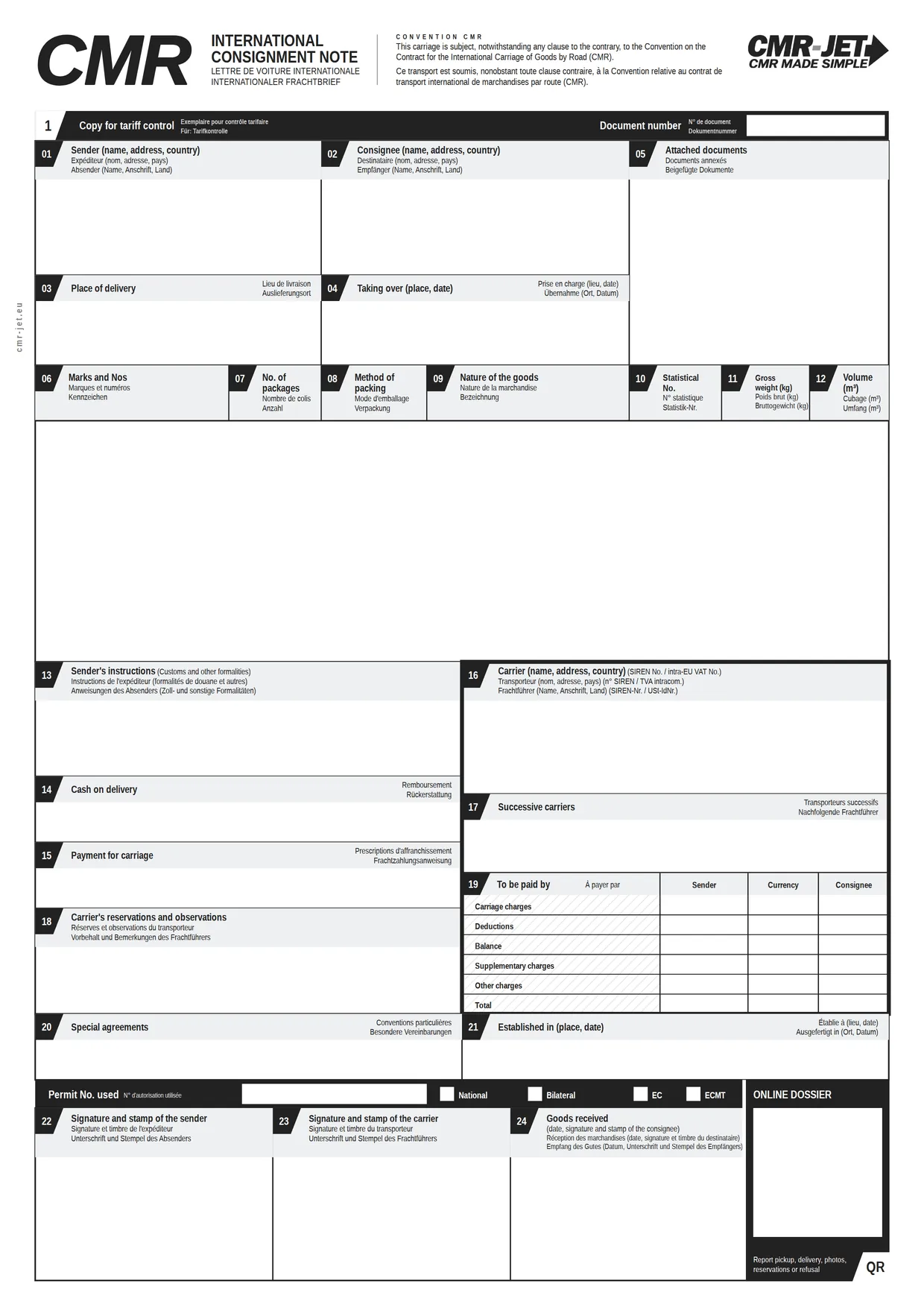
Printing the form: In Malta you can print a complete CMR consignment note yourself on blank paper.